Simple Interest, Explained Without the Jargon
Your bank statement says "3.5% simple interest" and you have no idea what your loan will actually cost you by the time it's paid off. Or maybe you're comparing two savings offers and can't tell which one actually pays more.
This guide breaks down the simple interest formula, walks through real examples, and shows you exactly where people get the math wrong.
What Simple Interest Actually Means
Simple interest is calculated only on the original amount you borrow or invest, called the principal. Unlike compound interest, it never grows based on interest you've already earned. That makes it easier to calculate, and usually cheaper for borrowers than compound interest over the same period.
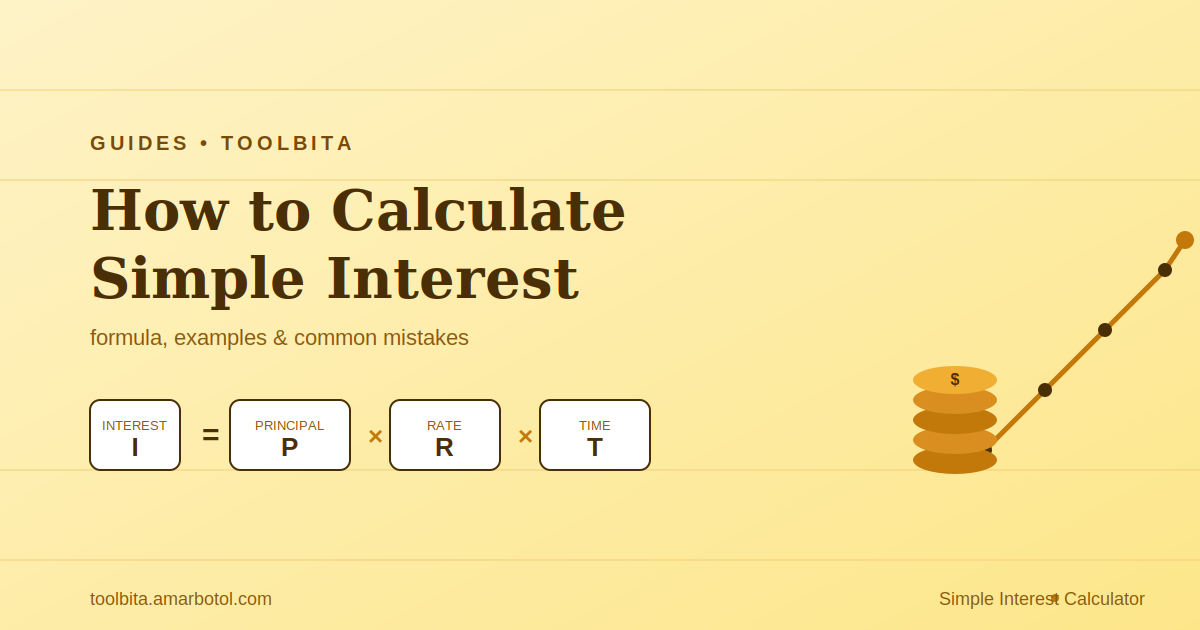
The formula is:
Interest (I) = P × R × T- P = Principal (the original amount)
- R = Annual interest rate (as a decimal, so 5% = 0.05)
- T = Time, in years
How to Calculate It Step by Step
- Write down your principal amount. Example:
$5,000. - Convert the interest rate to a decimal.
6%becomes0.06. - Determine the time period in years. If it's in months, divide by 12.
- Multiply all three:
5000 × 0.06 × 3 = $900. - Add the interest to the principal to get your total repayment:
$5,000 + $900 = $5,900.
Doing this by hand works fine for one calculation, but if you're comparing several loan offers or terms, plugging the numbers into our Simple Interest Calculator is faster and rules out arithmetic mistakes.
Worked Examples
| Time Period | Interest Earned | Total Repayment |
|---|---|---|
| 1 year | $500 | $10,500 |
| 3 years | $1,500 | $11,500 |
| 5 years | $2,500 | $12,500 |
Notice the interest grows in a straight line, $500 every year, because it's always calculated on the same $10,000. That's the defining feature of simple interest.
Simple Interest vs. Compound Interest
These two get confused constantly, and the difference matters for your wallet.
- Simple interest is calculated only on the principal, every time.
- Compound interest is calculated on the principal plus any interest already added, so it grows faster over time.
Simple interest is common for short-term loans, car loans, and some personal loans. Compound interest shows up in most savings accounts, credit cards, and mortgages. If you're borrowing, simple interest usually costs you less over time. If you're saving, compound interest earns you more.
Common Mistakes to Avoid
- Forgetting to convert time to years. An 8-month loan is
8/12 = 0.67years, not8. - Using the rate as a whole number. 5% must be
0.05in the formula, not5. - Mixing up interest with total repayment. The formula gives you the interest only; add the principal back to get what you'll actually pay or receive.
Useful Toolbita Tools
- Simple Interest Calculator — plug in your principal, rate and time to get instant results without doing the math by hand.
- Age Calculator — work out the exact time span between two dates, useful for the "T" in your formula on loans with odd start and end dates.
- Word Counter — before signing a loan or savings agreement, paste the terms in here to check you're not skimming past buried fine print.
Frequently Asked Questions
Is simple interest always cheaper than compound interest?
For borrowers, generally yes, since interest never compounds on itself. For savers, compound interest usually earns more over the same period.
Can simple interest apply to daily or monthly periods?
Yes. Just convert your time period into years first, for example 90 days is roughly 90/365 years.
Do banks use simple interest for savings accounts?
Rarely. Most savings accounts and credit cards use compound interest, while simple interest is more common in short-term personal and auto loans.