Why Most People Get Their BMI Wrong
You step on a scale, plug your weight into a random online form, and get a number that tells you nothing useful. Body Mass Index (BMI) is one of the most misunderstood health metrics because people either calculate it wrong or misread what the result actually means.
This guide shows you exactly how to calculate your BMI correctly, what the number means for your age and body type, and where it falls short as a health measure.
What BMI Actually Measures
BMI is a simple ratio of your weight to your height. It does not measure body fat percentage, muscle mass, or where fat is distributed on your body. It is a screening tool, not a diagnosis.
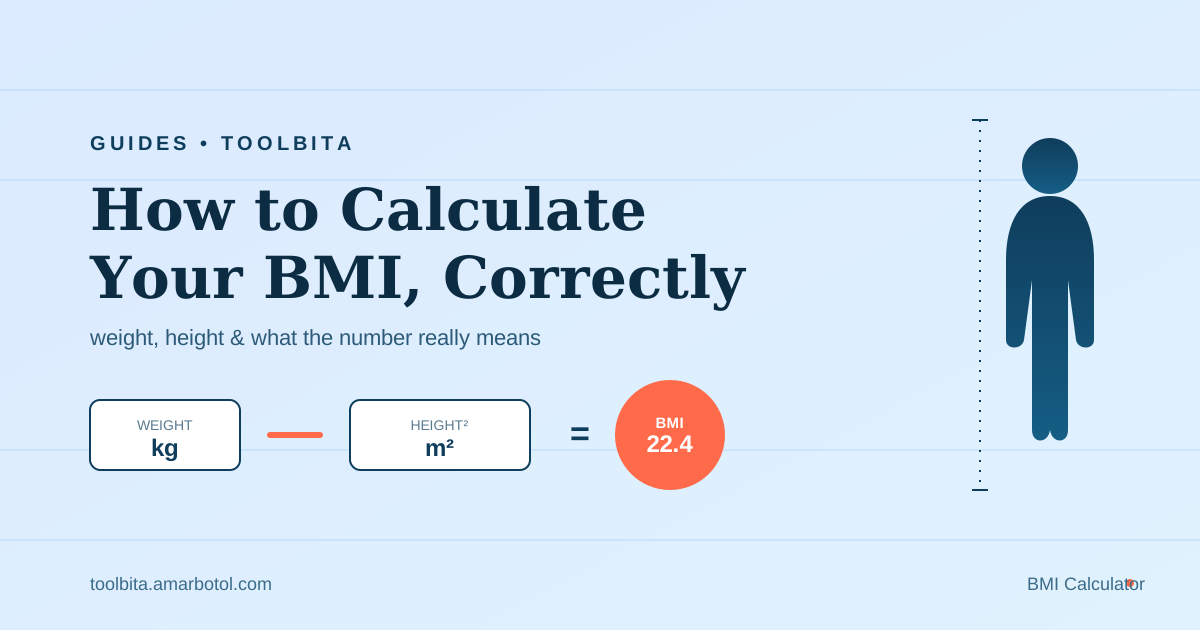
The formula is:
BMI = weight (kg) / height (m)²If you use pounds and inches instead, the formula changes slightly:
BMI = (weight (lb) / height (in)²) × 703How to Calculate BMI Step by Step
- Weigh yourself in the morning, before eating, for the most consistent reading.
- Measure your height without shoes, standing straight against a wall.
- Convert both measurements to the same unit system (metric or imperial).
- Apply the formula above, or skip the math entirely with a calculator.
Doing this by hand is easy to get wrong, especially with the imperial formula. A small rounding error in height, since it is squared, throws off the whole result. This is where using a dedicated BMI Calculator saves time and avoids mistakes.
How to Read Your BMI Result
| BMI Range | Category |
|---|---|
| Below 18.5 | Underweight |
| 18.5 – 24.9 | Normal weight |
| 25.0 – 29.9 | Overweight |
| 30.0 and above | Obese |
These ranges are designed for adults aged 20 and older. Children, teenagers, and older adults need different reference points, which is one reason BMI alone is not a complete picture.
Where BMI Falls Short
- Athletes and muscular people often score as "overweight" because muscle weighs more than fat.
- Older adults can have a "normal" BMI while carrying less muscle and more fat than the number suggests.
- Age itself changes how BMI should be interpreted, since body composition shifts over decades. Knowing your exact age helps put your BMI in context, which you can check quickly with our Age Calculator.
- Fat distribution matters more for health risk than total weight, and BMI does not capture this at all.
Use BMI as a starting point, not a verdict. If your number is outside the normal range, a conversation with a doctor is more useful than the number alone.
Useful Toolbita Tools
- BMI Calculator — get your BMI instantly without doing the math by hand.
- Age Calculator — find your exact age, useful context for interpreting your BMI correctly.
Frequently Asked Questions
Is BMI accurate for everyone?
No. It works reasonably well for the average adult but is less reliable for athletes, older adults, and people with unusual body compositions.
How often should I check my BMI?
Checking every few months is enough for most people. Daily or weekly checks usually just reflect normal weight fluctuation, not real change.
What is a healthy BMI range?
For most adults, 18.5 to 24.9 is considered the normal range, though individual health depends on more than this one number.